1993
FC privatisation threatened – again.
April
The purchase of Ledmore and Migdale (1756 acres) in the Scottish Highlands is our largest site to date and marks the Trust’s 21st anniversary.
We now own 609 woods (20,808 acres) across nearly every county and region in Britain. Trust publishes its Woodland Management Principles
1994
Kenneth Watkins, appointed Founder and President, relinquishes the Management Board Chair. The future of the Forestry Commission remains in doubt.
January
Andrew Bachell, the first director for Scotland, appointed (Andrew went on to become Policy Director at Scottish National Heritage).
July
Richard Mabey joins over 800 people at the handover of Tring Park (257 acres) saved from development as a hotel and golf course.
September
On the 10th anniversary of our first wood being purchased in Scotland, we receive our largest gift of land to date from Glenrothes Development Corporation covering 800 acres.
1995
The Millennium Commission awards our “Woods on your Doorstep” project £6.5 million. (The scheme would successfully complete the creation of 200 new community woods in England and Wales.) Sainsbury Family Trusts donate £525,000.
February
Stanley Edgcumbe dies aged 79, succeeded as Chairman by Theo White. Clive Anderson (later to become Trust President) endorsed the Trust as a “Celebri-tree“.
Newsletter 44 is the first issued under the “Broadleaf” banner with supplements for Scotland and Wales and English Regions.
1996
Kenneth Watkins dies after a short illness aged 86. One of his obituaries described him as “a tough, singled-minded decision taker – but full of kindness and compassion”.
November
Patrick Cregg appointed Northern Ireland Director to take up the challenge of creating 50 new “Woods on your doorstep” and developing the Trust in Northern Ireland.
October
Glen Finglas, near Callander, becomes our largest site to date at over 11,000 acres supported by a £1.4 million Heritage Lottery Fund grant. It is one of the largest native broadleaved woods in Scotland and is in the heart of Scotland’s first National Park.
1997
In May New Labour under Tony Blair win the General Election
October
The Trust celebrated its 25th anniversary on 10th October 1997
Following John James’ decision to step down at the end of April, after almost 20 years with the Trust, Mike Townsend is appointed the Trust’s second chief executive.
| 1972 – 1997 Over 25 years the Woodland Trust had acquired 842 woods covering 38,625 acres (15,657 ha) and had 150,000 supporters. Income in 1997 was almost £15 million making it one of the largest charities in the UK at that time. |
External Events
John Major became leader of the Conservative party and the government. Forestry Commission privatisation again threatened. In 1992 the UK signs the “Convention on Biodiversity” in Rio. At home conservationists continued to feel the repercussions of government agency re-organisations. Heritage Lottery funding provides a welcome source of grant aid. In 1997 Tony Blair wins a landslide General Election victory for New Labour.
Governance and Organisation
In 1994 KW (now aged 85) became “Founder and President” relinquishing the chair to his old colleague, Stanley Edgcumbe, who dies the following year aged 79 and is succeeded by Theo White. In 1996, after a short illness, KW died – 24 years after founding the Trust. While the Trust’s performance continued at a high level, I struggled to retain the Management Committee’s confidence. Charity law is being updated and governance is a topic of discussion. While the executive is adopting new ideas the Management Committee is reluctant to participate or delegate. Additional Trustees are appointed in much the same way as before: Tony Golding in 1993 (a younger man, at 53); Derek Gaulter, a retired barrister, and Michael Barton, retiring after many years as the Trust’s solicitor, in 1995. In 1996 Julian Purvis suggested Peter Oliver, an accountant and keen ornithologist. In 1997, as one of my last recommendations, I suggested Alan Bigg who was about to retire as Chairman of Brann, our advertising agency. The Trust is rapidly becoming one of the largest UK charities.
Promotions and Fundraising
Although membership had plateaued, appeal income increased year on year as we continued to develop new local fundraising skills and were by then acquiring, on average, a new property every week. Britain remained in recession and in spite of concerns about cash flow we somehow always managed to equal or exceed targets. The Millennium Commission’s pledge to “Woods on Your Doorstep “of £11.5million was the final impetus for the Trust to expand into Northern Ireland and Patrick Cregg was appointed Operations Director. Glen Finglas, bordering the Trossachs in Central Scotland, was our largest acquisition at over 11,000 acres made possible with a £1.4million grant from the Heritage Lottery Fund.
Conservation and Woodland Management
As Woodlands Operations Director, Philip Keeble had a very different style to his predecessors – not always welcomed by his colleagues but effective. In spite of organisational challenges, by 1992 we were working with increasingly large partners and our income, at over £5 million a year, gave us credibility. At this time Development Corporations and so-called New Towns were winding up and looking for organisations acceptable to government and capable of taking on their woodland areas. We had already had experience in 1988 in Tyne and Wear at the James Steel Park but hadn’t at that time thought to negotiate an endowment – a sum to cover future management costs. We realised that we could convert our experience in managing woods into sizable financial sums. Warrington and Runcorn Development Corporation was the first to sign up with an endowment of over £880,000 followed by Preston and Chorley and in Scotland with Glenrothes in Fife and Livingston in West Lothian. Andrew Bachell joined as Scottish Operations Director in 1994.
Postscript
In spite of many successes I found it increasingly difficult to retain the confidence of the Management Committee and eventually it caused friction within the executive and between the executive and the Committee. I had previously clashed with the Committee over organisational changes and seriously considered leaving the Trust. Sometime before the Founders’ death I had broached the possibility of ending my contract. The previous year I had received an OBE for services to nature conservation and had been with Trust for almost 20 years. I felt that if I couldn’t initiate the changes I wanted within the Management Committee and the executive someone else would have to. It made sense to plan my departure and the Committee agreed. Following my decision to step down, Mike Townsend was appointed the Trust’s second chief executive.
Achievements
Over 25 years the Woodland Trust had acquired 842 woods covering 38,625 acres (15,657 ha) and had 150,000 supporters. Income in 1997 was almost £15 million making it one of the largest charities in the UK at that time.
Related Posts:
COP OUT
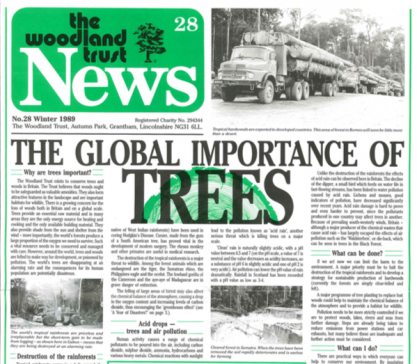
“The ‘greenhouse effect’ is with us now. We need to respond, and quickly, if we are to rescue our planet from disaster.” These words were not stated at COP 26 in Glasgow in 2021 as you might think but in the Woodland Trust’s Newsletter 28 published in 1989. Over 30 years ago the Trust was […]